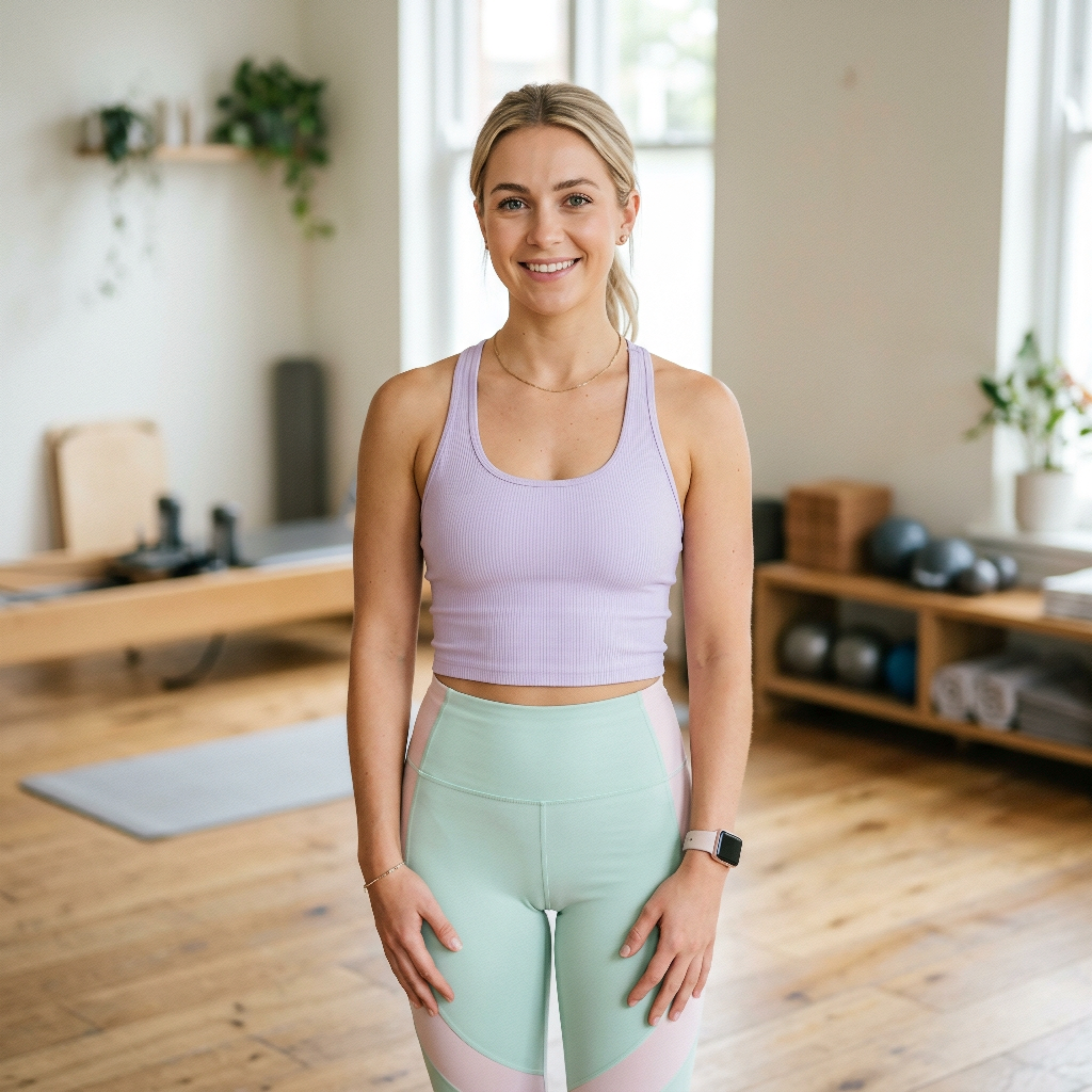
Clinical Pilates Instructor · Author
Sophie Mercer
Fifteen years turning “the surgery was a success” back into a body that actually works.
Sophie is a clinical Pilates instructor with 15+ years of teaching, 4,000+ hours of one-on-one client work, and a documented practice across 2,000+ clients in chronic pain, post-surgical recovery, and movement dysfunction. She is the creator of the Mercer Biomechanical Framework and the author of The Mercer Method book series and 35 condition-specific protocols.
The story
Why a healed joint isn't a recovered one
Sophie didn't set out to write protocols. She set out to answer one question that kept walking into her studio: “My scan is clear, my surgeon discharged me — so why doesn't it work?”
She began her Pilates training in the early 2010s after watching, again and again, how poorly people with chronic musculoskeletal pain were served by generic exercise. A herniated disc was handed the same sheet of stretches as a stiff back. A new hip got the same advice as a sore one: rest, and wait for it to heal. The tissue healed. The function didn't.
So she trained where the science was: Polestar Pilates, the rehabilitation-focused school co-founded by physical therapists, with a curriculum built on motor learning and movement science. She earned the PMA-CPT — the industry's most rigorous credential — and then did the thing that no textbook can shortcut. She taught. Four thousand hours, one body at a time.
“Tissue heals on a biological timeline you can't rush. Function comes back on a training timeline — and it doesn't come back on its own. ‘Waiting for it to heal’ is exactly how a perfect operation ends in a permanent limp.”
Across those hours a pattern emerged that no single condition could explain on its own. When a joint is injured or operated on, the nervous system quietly switches off the muscles around it — the quadriceps after a knee replacement, the gluteus medius after a new hip, the rotator cuff around a frozen shoulder, the deep spinal stabilisers around a disc. That muscle stays off, wasting, while the body limps and lurches and shrugs to work around it — until something deliberately switches it back on.
That pattern became the Mercer Biomechanical Framework. The framework became 35 condition-specific protocols. And in 2026 those protocols became books — so the work that had only ever happened inside a London studio could finally reach the people who needed it and would never get through the door.
The books
Author of The Mercer Method
A clinical book series that takes the exact reasoning Sophie uses with private clients and puts it in your hands — week by week, phase by phase, with the precautions stated out loud.
Volume One: Pain Foundations
The five foundational protocols and the full biomechanical framework — sciatica, lower-back pain, posture collapse, desk-worker neck and shoulder tension, and movement after 60.
Buy on Amazon →Volume Two: Joint Recovery
Five clinical protocols for post-surgical and structural recovery — frozen shoulder, knee replacement, hip replacement, herniated disc, and shoulder impingement. Why a healed joint is not a recovered one.
Buy on Amazon →Both volumes share one clinical framework and stand completely on their own. See Sophie's Amazon author page →
The method
The Mercer Biomechanical Framework
Rather than prescribing exercises by symptom, the framework analyses every condition through three sequential phases. The phases cannot be skipped — with a recovering joint, the order is the medicine.
Decompression
Reduce the mechanical or neural load currently driving the symptom — lumbar unloading for sciatica, scapular release for a frozen shoulder, intra-abdominal pressure management for a postpartum core.
Stabilisation
Rebuild the deep stabilising system specific to that region — transverse abdominis, multifidus, pelvic floor, deep neck flexors, rotator cuff, gluteus medius — so the load doesn't return.
Integration
Progressively reintroduce the functional patterns the condition compromised: sitting, walking, lifting, reaching, sport, sleep — until you stop thinking about the joint at all.
Every protocol follows this structure, with exercises, dosages, and milestones varying by condition. It aligns with current evidence on graded exposure and motor-control retraining — see the clinical evidence library for the underlying research.
The receipts
Credentials & Certifications
- PMA-Certified Pilates Teacher (PMA-CPT) Pilates Method Alliance — the international industry standard. Requires a minimum of 450 hours of comprehensive training, documented teaching hours, and a written examination.
- Polestar Pilates Comprehensive Certification Rehabilitation-focused programme co-founded by physical therapists, with curriculum drawn from motor learning and movement science.
- Clinical Rehabilitation Specialist Advanced specialisation in post-surgical recovery, chronic pain, and clients referred by physiotherapists and orthopaedic clinicians.
- Pre & Postnatal Pilates Certification Specialist training in modifications for pregnancy, diastasis recti recovery, and pelvic floor rehabilitation.
- Mat & Reformer Pilates Certification Comprehensive training across both apparatus, with all home protocols designed exclusively for mat-based delivery.
- Continuing Education: Neural Mobilisation for Pilates Instructors Targeted training on the neural gliding techniques used throughout the Sciatica Relief and Herniated Disc Recovery protocols.
The range
Areas of Specialisation
Spine & Lower Back
Lower back pain, herniated and bulging discs, sciatica, SI joint dysfunction, scoliosis, neck pain.
Post-Surgical Recovery
Hip replacement, knee replacement, shoulder surgery, post-caesarean recovery.
Women's Health
Pre and postnatal Pilates, diastasis recti, pelvic floor rehabilitation, perimenopause and osteoporosis.
Sport-Specific
Programming for golfers, cyclists, swimmers, runners, tennis players, climbers, surfers, BJJ/MMA, rugby, and equestrian athletes.
Chronic Pain & Nerve Conditions
Sciatica, piriformis syndrome, thoracic outlet symptoms, plantar fasciitis, shoulder impingement, frozen shoulder.
Posture & Profession
Desk workers, musicians, drivers, healthcare workers, and clients in postural-load occupations.
“I don't believe in generic programmes. A herniated disc isn't a stiff back. A frozen shoulder isn't an impinged one. Pre-natal isn't post-natal. The body keeps showing me, again and again, that the more specific the work, the better the outcome.” — Sophie Mercer
The catalogue
Published Protocols
Sophie is the author of all 35 protocols in the Pilates Protocols catalogue — each a downloadable programme with a defined weekly schedule, exercise progressions, and recovery-tracking tools.
Pain & Injury Recovery
- The 8-Week Pilates Program for Fibromyalgia Relief
- The 10-Week Pilates Program for Frozen Shoulder Recovery
- The 12-Week Pilates Program for Herniated Disc Recovery
- The 12-Week Pilates Program for Hip Replacement Recovery
- The 12-Week Pilates Program for Knee Replacement Recovery
- The 8-Week Pilates Program for Lower Back Pain
- The 6-Week Pilates Program for Neck and Upper Back Pain
- The 6-Week Pilates Program for Plantar Fasciitis Relief
- The 8-Week Pilates Program for Sciatica Relief
- The 8-Week Pilates Program for Shoulder Impingement Recovery
- The 8-Week Pilates Program for SI Joint Pain
Sport-Specific
- The 8-Week Pilates Program for BJJ and MMA Fighters
- The 8-Week Pilates Program for CrossFit Athletes
- The 8-Week Pilates Program for Cyclists
- The 8-Week Pilates Program for Football (Soccer) Players
- The 8-Week Pilates Program for Golfers
- The 8-Week Pilates Program for Horse Riders
- The 10-Week Pilates Program for Marathon Runners
- The 8-Week Pilates Program for Rock Climbers
- The 8-Week Pilates Program for Rugby Players
- The 8-Week Pilates Program for Runners with Knee Pain
- The 6-Week Pilates Program for Skiing and Snowboarding
- The 8-Week Pilates Program for Surfers
- The 8-Week Pilates Program for Swimmers
- The 8-Week Pilates Program for Tennis Players
- The 10-Week Pilates Program for Triathletes
Women's Health & Life Stage
Body Region & Posture
Profession & Wellbeing
- The 8-Week Post-GLP-1 Pilates Reshape Protocol
- The 6-Week Pilates Program for Desk Workers with Lower Back Pain
- The 6-Week Pilates Program for Musicians
- The 6-Week Pilates Program for Posture Correction
- The 6-Week Pilates Program to Get You Reformer Ready
- The 8-Week Pilates Program for Reformer-Style Results at Home
- The 6-Week Pilates Program for Stress and Anxiety Relief
Free reading
Articles & Guides
Free educational writing by Sophie, covering common conditions, techniques, and frequently asked clinical questions.
- A 20-minute beginner reformer Pilates workout you can do at home (no machine)
- 28 day wall Pilates challenge: the free 4-week plan (and what it can really do)
- The best exercises for diastasis recti: 8 moves ranked, with cues and what to avoid
- Breathing exercises for stress and anxiety: how to calm your nervous system
- Can Pilates help sciatica? What the evidence says
- Chair Pilates exercises: 10 seated and standing moves you can do anywhere
- Chair Pilates for seniors: does it work, and where to start
- Clinical Pilates vs Regular Pilates: What's the Difference?
- Core exercises for runners: build the stability that protects your stride
- Deep core exercises for diastasis recti: the transverse abdominis progression that works
- Diastasis recti exercises for men: causes, what to avoid, and how to rebuild the core
- Does Pilates Help Sciatica? What Quora Actually Says (2026)
- Does wall Pilates work? An honest clinical verdict
- Does Wall Pilates Actually Work? What Reddit Says (2026)
- Exercise after stopping Ozempic: how to keep the weight off
- Exercises for a herniated disc: what helps and what to avoid
- Exercises for diastasis recti: how to safely close the gap
- Exercises for hip pain: how to tell the cause and what helps
- Exercises for a hypermobile SI joint: stability work for a pelvis that moves too much
- Exercises for mild scoliosis: what to do at the 'watch and strengthen' stage
- Exercises for neck pain: gentle moves that actually relieve the ache
- Exercises for plantar fasciitis: what actually works (and what makes it worse)
- Exercises good for scoliosis: 10 moves for elongation, strength, breathing and core
- Exercises for shoulder impingement: relieving the pinch safely
- Exercises for SI joint pain in pregnancy: safe relief for a loosening pelvis
- Exercises for thoracic scoliosis: breathing into the curve and easing a rib hump
- Exercises for upper back pain: relief for the area between your shoulder blades
- Exercises to improve posture: a clinical guide to standing tall again
- Exercises to relax the pelvic floor: how to release a tight, overactive pelvic floor
- Exercises to strengthen the SI joint: building the support your pelvis is missing
- Frozen shoulder exercises you can safely do at home
- Glute strengthening exercises: how to wake up weak glutes
- Hamstring stretches: how to loosen tight hamstrings for good
- How Long Does Pilates Take to Improve Posture?
- How Long Does Pilates Take to Work for Lower Back Pain?
- How Long Does Pilates Take to Work for Sciatica?
- How to prepare for your first reformer Pilates class
- How to preserve muscle on Ozempic, Mounjaro & other GLP-1s
- How to release tight hip flexors: stretches and strength that last
- Is Pilates good for arthritis? A guide for osteoarthritis and rheumatoid arthritis
- Is Pilates good for a bulging disc? The exercises that help and the ones to avoid
- Is Pilates good for fibromyalgia? Pacing, gentle exercises and avoiding the crash
- Is Pilates good for hip bursitis? Exercises that help lateral hip pain (and the stretches to avoid)
- Is Pilates good for osteoporosis? What's safe, what to avoid, and how to start
- Is Pilates good for spinal stenosis? Flexion-based exercises that help, and what to avoid
- Is Pilates good for weight loss? An honest answer
- Is Pilates Good for Weight Loss? What Reddit Really Says (2026)
- Is Pilates safe during pregnancy? A trimester-by-trimester guide
- Is reformer Pilates worth it? An honest cost-benefit guide
- Is Reformer Pilates Worth It? What Quora Actually Says (2026)
- Is Reformer Pilates Worth It? What Reddit Really Thinks (2026)
- Knee replacement exercises: a safe progression for full recovery
- Lohnt sich Reformer Pilates? Ehrliche Kosten-Nutzen-Analyse
- Lower back exercises for scoliosis: strengthening and decompressing a lumbar curve
- Ozempic butt: exercises to firm and reshape your glutes
- Pelvic floor exercises during pregnancy: when to start and how to do them
- Pelvic floor exercises for uterus prolapse: what helps, what to avoid, and when to get help
- Pilates after hip replacement: when can you start and what to expect
- Pilates After Ozempic: What Quora Actually Says (2026)
- Pilates After Ozempic: What Reddit Says About Keeping Your Shape (2026)
- Pilates ball exercises for lower back pain: 8 stability ball moves that actually help
- Pilates ball exercises for pregnancy: 8 safe moves, ball sizing and trimester notes
- 5 Pilates exercises every desk worker with back pain needs
- Pilates exercises for sciatica: 8 moves that calm the nerve (and the ones to avoid)
- Pilates exercises for scoliosis: the repertoire adapted for a curved spine
- Pilates for athletes: why the strongest competitors train their core
- Pilates for Beginners: What Reddit Actually Recommends (2026)
- Pilates for Desk Workers: What Reddit Actually Recommends (2026)
- Pilates for Diastasis Recti: Before and After (What to Realistically Expect)
- Pilates for Diastasis Recti: What Reddit Actually Recommends (2026)
- Pilates for Frozen Shoulder: What Reddit Actually Recommends (2026)
- How Pilates improves your golf game (and prevents injury)
- Pilates for a Herniated Disc: What Reddit Actually Recommends (2026)
- Pilates for hypermobility: why stability beats stretching, and how to train safely
- Pilates for kyphosis: exercises for a rounded upper back (and when it isn't just posture)
- Pilates for lower back pain: does it actually work?
- Pilates for Lower Back Pain: What Quora Actually Says (2026)
- Pilates for Lower Back Pain: What Reddit Actually Recommends (2026)
- Pilates for neck and shoulder pain: exercises that release tension and rebuild support
- Pilates for Neck Pain: What Reddit Actually Recommends (2026)
- Pilates for Pelvic Floor: What Reddit Actually Recommends (2026)
- Pilates for piriformis syndrome: exercises that release the deep glute and calm the sciatic nerve
- Pilates for posture correction: 7 moves that rebuild how you stand
- Pilates for Posture: What Reddit Actually Recommends (2026)
- Why every runner with knee pain should try Pilates
- Pilates for Sciatica: What Reddit Actually Recommends (2026)
- Pilates for Scoliosis: What Reddit Actually Recommends (2026)
- Pilates for tight hips: hip-opening exercises that restore mobility (and why stretching alone fails)
- Pilates Over 60: What Reddit Actually Recommends (2026)
- 12 Pilates reformer exercises for beginners (with spring settings)
- Pilates ring exercises for seniors: 8 magic circle moves for strength and posture
- Pilates vs Chiropractor for Sciatica: Which Actually Helps?
- Pilates vs the McKenzie Method for a Herniated Disc
- Pilates vs Physical Therapy for Back Pain: Which Should You Choose?
- Pilates vs yoga for back pain: which is better?
- Pilates vs Yoga for Back Pain: What Reddit Recommends (2026)
- Postpartum core recovery: how to rebuild safely with Pilates
- PT exercises for SI joint dysfunction: what a physio would give you, and how Pilates progresses it
- Buying a reformer vs a studio membership: the 5-year cost math
- Reformer Pilates at home — without the $3,000 machine
- The reformer Pilates cheat sheet: 20 moves you'll meet in your first class
- Reformer Pilates: benefits vs cost — the honest 2026 breakdown
- Reformer Pilates for beginners over 50 — what to know before you start
- Reformer Pilates for beginners — what to expect (and what nobody tells you)
- Reformer Pilates for lower back pain: does it help, and can you get the same results at home?
- Reformer Pilates for men — what it actually does for male physiology
- Reformer Pilates for pregnancy: is it safe, and how to modify it trimester by trimester
- Pilates reformer for seniors: is it safe, who should avoid it, and mat alternatives
- Reformer Pilates prices in Singapore (2026): what you'll really pay
- Reformer vs Mat Pilates for Back Pain: Which Is Better?
- Reformer vs mat Pilates for beginners — which should you start with?
- Reformer vs Mat Pilates: What Reddit Really Says (2026)
- Schroth method exercises for scoliosis: an honest guide
- Sciatica Exercises at Home: A Complete Daily Routine
- Sciatica Exercises for Seniors: A Gentle Clinical Guide
- Sciatica Exercises in Bed: Gentle Moves to Start the Day
- Scoliosis core exercises: why crunches are wrong and what to do instead
- Scoliosis Exercises for Seniors: A Gentle Clinical Guide
- Scoliosis exercises to avoid (and what to do instead)
- Scoliosis rehabilitation exercises PDF: what a good one contains (free week inside)
- SI joint exercises PDF: a printable daily routine for sacroiliac pain
- SI joint pain exercises: how to release and stabilise the sacroiliac joint
- SI joint pain exercises to avoid (and the safer swaps that help)
- Standing Pilates for seniors: 8 exercises for balance, bone strength and confidence
- Stretching exercises for scoliosis: 10 safe stretches (and what to skip)
- Stretching exercises for the SI joint: what helps, what harms, and how to do it
- Wall Pilates exercises: 12 moves and a free 20-minute workout
- Wall Pilates for seniors: 8 safe exercises for balance and strength after 60
- Weight-bearing exercises for osteoporosis: building bone safely
The standards
Publishing & Editorial Principles
Every protocol and article published under Sophie Mercer's name adheres to the following:
- Clinically grounded. All programming is drawn from documented teaching experience. No protocol is published until it has been delivered to and refined with private clients.
- Evidence-aligned. Where clinical research and guidelines (e.g. NICE, peer-reviewed RCTs) exist, protocols are designed to align with them. Citations are kept in the public clinical evidence library.
- Conservative on contraindications. Known red flags — cauda equina symptoms, post-surgical timelines, blood-pressure cautions in pregnancy — are stated explicitly, and the protocol defers to medical clearance.
- Honest about limits. These are self-directed educational programmes — not a substitute for personalised medical assessment, physiotherapy, or surgery. This is stated openly on every product page.
- Reviewed for accuracy. Anatomical terminology, condition descriptions, and exercise prescriptions are reviewed against current clinical references before publication.
Find the protocol for your situation
Start with a book, browse the full catalogue, or reach out directly. Everything Sophie publishes is built to do one thing — give you back a body you've stopped thinking about.
Press, questions, or collaboration: contact@pilatesprotocols.com
Also on Medium, Quora, Pinterest, and LinkedIn.